Payment timing isn't a payments problem. It's an operating system problem. Mastercard's Mark Barnett is right that timing is the currency small businesses actually trade in — but timing visibility and timing control don't come from a faster rail. They come from a connected system that shows a small business its true cash position in the place it already works.
That place is the checking account.
Why payment timing isn't really a payments problem
In a recent PYMNTS conversation, Barnett argued that the real competition for small businesses isn't between cash and cards. It's "between constrained and unconstrained liquidity." He's right. Mastercard's research shows nearly half of SMBs would pay for tools that help them adjust payment timing to when money actually lands.
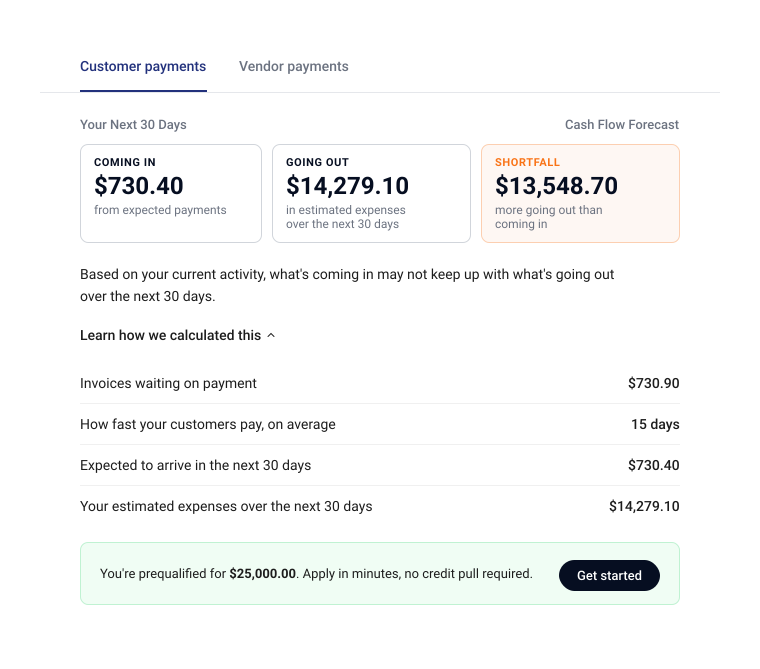
But that data points somewhere bigger than a new card feature or an agentic assistant. A small business owner doesn't ask, "which rail?" They ask, "can I make payroll Friday?" Answering that question requires visibility across money coming in, money going out, and money available to borrow — all in one view.
That's not a payments question. That's an operating system question.
What a small business operating system actually requires
A functional operating system for a small business has to hold four capabilities together: receivables, payables, accounting, and lending. Each one, alone, is a point solution. Together, connected through a single accounting ledger, they show the owner what's true about their cash today and what's likely true next week.
The industry has spent a decade building these capabilities as separate apps. The owner ends up reconciling between a payments app, an invoicing app, an accounting app, and a lender they met online. Timing visibility gets lost in the gaps between them.
Barnett's framing exposes the cost of that fragmentation. If timing is the currency, a disconnected stack is a tax on the business.
Why the checking account is the natural operating system
Every small business already has a checking account. It's where revenue actually lands and where bills actually get paid. It's the relationship the owner already trusts. And it's the one place where a real-time view of cash isn't an estimate — it's the source of truth.
For the last decade, fintech apps like Square, Stripe, Shopify, and QuickBooks built the operating experience outside the financial institution. They captured the workflow, and with it, the data. The checking account became a settlement endpoint rather than the place a business is run from.
That's the shift worth watching. The checking account is the natural operating system for a small business. The data should stay with the institution that already holds the account.
How Autobooks fits the structural argument
This is what Autobooks is built for. Autobooks connects financial institutions and small businesses through one connected solution inside digital banking. Receivables, payables, accounting, and lending sit together, tied through one accounting ledger, in the digital banking experience the small business already uses every day.
That's not a payments upgrade. It's an operating system for the small business, delivered by the financial institution the business already trusts. Timing visibility becomes a native part of the account, not a bolt-on.
Autobooks is trusted by thousands of financial institutions and their small businesses for exactly this reason.
What this means for financial institutions
For a financial institution, the strategic question Barnett raises is sharper than it looks. If payment timing is what the small business is buying, and timing visibility requires a connected system, then whoever owns that system owns the primary relationship.
Defending the primary relationship is no longer about deposit pricing or a business debit card. It's about whether the checking account is the place the business actually gets run — or a pipe to somewhere else.
What this signals for investors
For investors watching the category, the signal is clearer than any single product launch. The market is moving from point solutions to connected systems. Standalone receivables tools, standalone payables tools, standalone accounting tools, and standalone small business lenders are being re-bundled around the account where the cash actually lives.
Barnett is describing the demand side of that shift. The supply side is the checking account finally becoming what a small business has needed it to be all along: an operating system, not a ledger of what already happened.