|
|
Missed the webinar? |
In short
- Most banks add small business capabilities but stall on adoption — insight alone doesn't move deposits.
- A 90-day flywheel turns insight into repeat usage through five coordinated moves: target, activate, deepen, measure, and repeat.
- The goal isn't a one-time campaign; it's a cycle that compounds every quarter.
- The Autobooks Resource Kit gives FIs the templates, plays, and measurement frameworks to run the flywheel themselves.
Why isn't insight alone enough to protect small business deposits?
Earlier in this series, we explored why small business banking is not broken. Internal alignment is. And we showed how construction and skilled trades businesses represent a tangible growth opportunity inside your market. But knowing where growth lives and capturing it are two very different things. In most institutions, capabilities get added. Campaigns get launched. And adoption stalls.
Insight alone does not protect deposits. Execution does.
The small business flywheel is how you close that gap. It aligns ownership, outreach, and measurement so critical workflows are solved inside your institution, not outside it.
Because when payment collection, invoicing, and cash flow management are not handled well inside the FI relationship, small businesses do not wait. They look elsewhere. Increasingly, they turn to third-party providers and large national banks that bundle those tools with accounts, lending, and deeper financial services.
That is the competitive reality.
What are the five moves that turn small business insight into adoption?
Growth compounds when usage compounds. Adding capabilities is necessary. Ensuring they are adopted consistently and at scale is what protects and grows relationships. Institutions that consistently move small business engagement forward tend to operate with discipline.
1. Assign Clear Ownership
Small business often lives between retail and treasury. When ownership is blurred, execution slows. The flywheel works when one person is accountable for outcomes. Not just implementation, but adoption, usage, and feedback.
When no one owns adoption, no one owns the outcome. In a market where fintech competitors move quickly, internal clarity becomes a competitive advantage.
2. Run a Focused 90-Day Campaign
Adoption requires sustained attention.
A 90-day campaign forces alignment:
- Defined targeting
- Coordinated internal training
- Structured outreach
- Weekly measurement
- Intentional follow-up
It shifts the organization from passive awareness to active engagement. Not a launch. A managed initiative.
Small businesses do not evaluate tools on a product roadmap timeline. They evaluate them in moments of friction. A focused campaign increases the likelihood that your solution is visible in that moment.
3. Rally Around a Defined Cohort
This is about alignment, not exclusion. General awareness across your small business base should continue. But when you want measurable movement and measurable deposit impact, focus matters.
Choosing a cohort allows you to:
- Speak directly to a specific workflow
- Equip frontline teams with sharper conversations
- Target marketing with practical use cases
- Measure impact cleanly
Construction and Skilled Trades is a strong starting point for many institutions because it is payment-driven, locally significant, and often underserved by traditional treasury tools. A focused campaign in a segment that represents 15 to 20 percent of the small businesses in your market can materially move payment volume.
Next quarter, it might be nonprofits or professional services. The approach scales.
Focus creates traction. Traction compounds.
4. Measure Behavior, Not Just Activation
Enrollment is intent. Usage is proof.
If the goal is to protect and deepen small business relationships, measure the behaviors that indicate a real shift:
- First payment
- Repeat activity
- Engagement within the first 90 days
When usage becomes repeat behavior, the workflow moves inside the FI relationship. That is when deposits stabilize, monetization strengthens, and competitive risk declines. If you only measure sign-ups, you will celebrate too early and miss the bigger opportunity.
5. Reinforce From the Frontline
Frontline teams are the bridge between awareness and habit. When they understand how a solution improves a specific workflow, and when they see real examples of it working, adoption increases.
Stories matter.
Specific use cases matter.
Follow-up matters.
Reinforcement reduces hesitation internally and externally. Confidence accelerates adoption.
How does the Autobooks resource kit support small business growth campaigns?
The flywheel is a strategy. Execution is where programs either accelerate or stall. To support a focused campaign around Construction and Skilled Trades, we built a resource kit that aligns directly to the steps above.
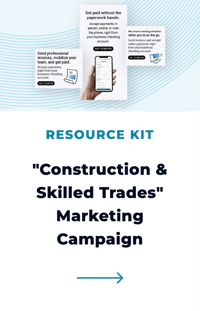 Inside, you will find:
- A training toolkit to prepare your internal teams
- Step-by-step guidance for identifying and assisting businesses through onboarding
- Instructions for segmenting your target cohort in the Autobooks Hub
- Pre-written email campaigns tailored to Construction and Skilled Trades
- Digital ad assets to support targeted outreach
- A framework for measuring campaign performance
It is built to help your team move from insight to coordinated execution quickly and intentionally.
A Practical First StepStart with the businesses that have already shown intent. Use the Autobooks Hub to identify small businesses that have accepted terms, been approved, or are active. Segment your chosen cohort. Launch targeted outreach. Track repeat usage. Follow up intentionally. Then refine and repeat with the next segment. That is the flywheel in motion. |
Watch the Recording and Join Session 3If you missed part two of the Q1 FI Growth Series, you can watch the recording and register for the next session here. If you are ready to activate a focused campaign, start with the Construction and Skilled Trades Resource Kit. |
Frequently asked questions
What's a small business flywheel in banking?
A repeatable cycle where targeted outreach produces initial usage, initial usage produces engagement data, engagement data informs the next wave of outreach, and so on. Each loop compounds adoption inside a segment instead of starting from zero with every campaign.
What are the five moves in the flywheel?
Target a specific segment, activate the right capabilities for that segment, deepen usage with purposeful next-step prompts, measure real adoption (not awareness), and repeat with the next segment or the next product. The sequence matters.
Why 90 days?
Long enough to see real adoption signal in the data; short enough to keep execution tight and unambiguous. A 90-day horizon forces scope decisions that quarter-long planning cycles tend to avoid.
Who inside the bank should own the flywheel?
Someone with enough authority to coordinate across product, marketing, and branch operations. Small business banking breaks when it sits between retail and commercial without a clear owner — the flywheel forces the ownership question.
What's in the Autobooks Resource Kit?
Campaign templates, segment playbooks, and measurement frameworks for each of the five moves. It's designed to let an FI run the flywheel with its own people rather than requiring consulting engagement.