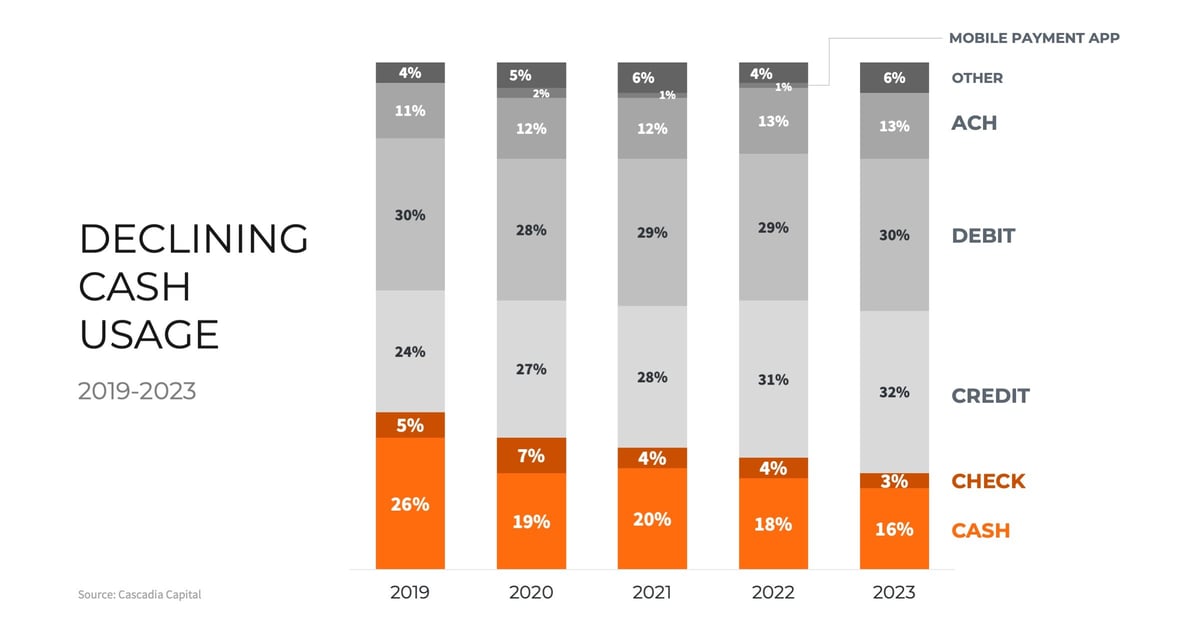
The U.S. is moving away from cash transactions. Cash usage in U.S. transactions has dropped from 32% in 2017 to 16% in 2023, with projections showing a further decline to 11% by 2027. This shift signals an urgent need for businesses to embrace digital payments or risk losing customers. With digital transactions becoming more prevalent, small businesses need to stay competitive by offering digital payment options that enhance customer experience and improve operational efficiency.
In short
- Cash usage has dropped from 32% of U.S. transactions in 2017 to 16% in 2023 — projected to fall to 11% by 2027.
- 80% of U.S. consumers now prefer contactless transactions; FedNow and other rails are accelerating the shift further.
- Small businesses without digital payment options risk losing customers, and banks without embedded acceptance risk losing those small businesses.
- Invoicing, card and ACH acceptance, and Tap to Pay — delivered inside digital banking — let the small business modernize without leaving the bank.
What's driving the decline of cash usage in the U.S.?
Several key drivers are contributing to the decline of cash usage in the U.S.:
- Increased digital banking adoption: Over 65% of small businesses now rely on fintech solutions for financial management.
- Consumer preference for contactless payments: Driven by pandemic-related behavioral changes, 80% of U.S. consumers now prefer contactless transactions over cash.
- Regulatory and industry shifts: Initiatives such as the Federal Reserve’s FedNow service are accelerating digital payments.
Why is cash losing ground to digital payments?
Convenience, security, and speed are the major drivers behind the decline in cash transactions. Digital payments allow businesses to process transactions faster, reduce theft risk, and improve accounting efficiency. Customers, in turn, benefit from a frictionless checkout experience. Moreover, the increasing popularity of contactless payments and mobile-based transactions further accelerates the decline of cash usage across industries.
Autobooks equips small businesses with digital invoicing and payment tools, making it easy to transition away from cash. By integrating with bank accounts and allowing customers to pay digitally through cards and ACH transfers, Autobooks helps small businesses modernize their payment processes.
Frequently asked questions
How fast is cash usage declining?
From 32% of U.S. transactions in 2017 to 16% in 2023, with projections showing a further drop to 11% by 2027. The direction is clear; the question is how quickly small businesses adapt.
What's driving the shift?
Rising digital banking adoption among small businesses (65%+ now use fintech tools), consumer preference for contactless (80%), and new infrastructure like FedNow that speeds up settlement.
What does a small business need to stop losing customers to cash-only friction?
At minimum: digital invoicing with a payment link, card and ACH acceptance, and contactless in-person payments via Tap to Pay. All of which can live inside the business's existing digital banking.
Why does embedded acceptance matter to the bank?
When the business accepts payments through the bank's digital channels, deposits stay in the institution. When it accepts payments through a third-party app, those deposits — and the relationship — are one login away from leaving.