|
|
Missed the webinar? |
In short
- Small business demand is not the problem. Millions of accounts, constant new-business formation, and rising owner engagement all prove the market is there.
- Results are weak because small business banking sits between retail and treasury without a clear owner, strategy, or metrics.
- Growth doesn't come from more capabilities; it comes from intentional design — choosing a segment, choosing a lead capability, and measuring adoption.
- Adoption is the real bottleneck. Every bank already has the customers; what's missing is the system to turn them into active users.
Is weak small business demand the reason banks underperform?
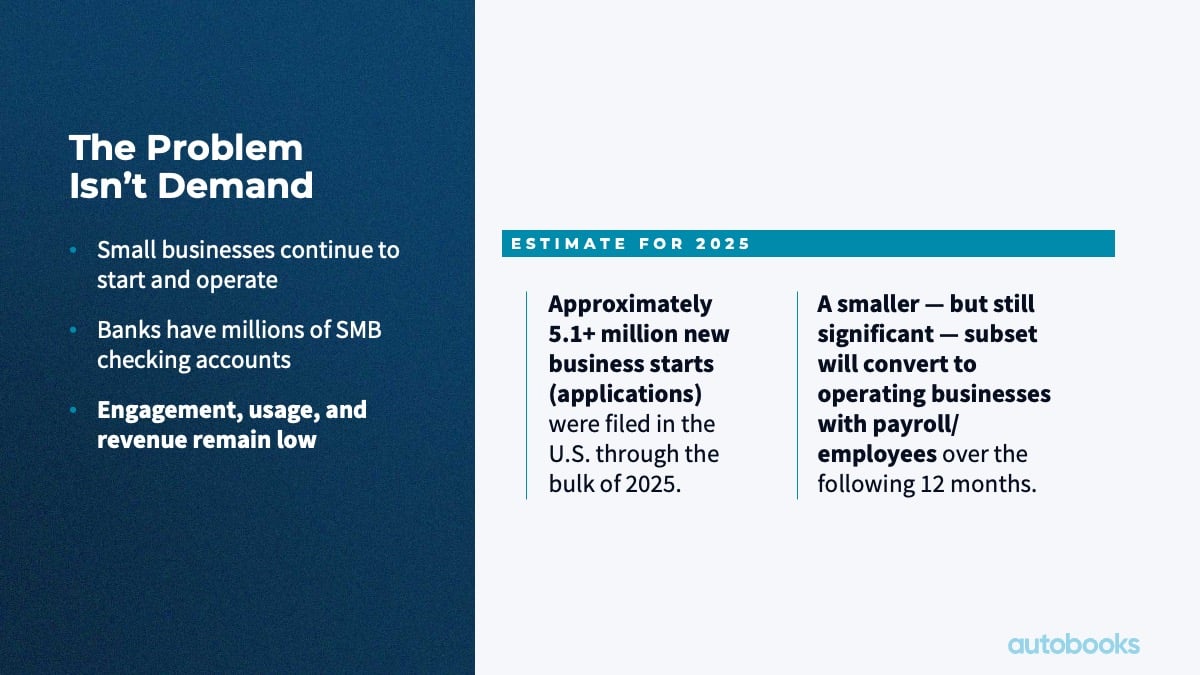
Small businesses continue to form at scale. Banks already hold millions of small business checking accounts. Yet engagement, usage, and revenue remain low.
That contradiction matters.
If demand were the issue, the story would be different. The reality is simpler and harder to confront. Small business banking underperforms because it is rarely owned, designed, or measured like a growth business.
Why is fragmentation the default operating model in small business banking?
In most institutions, small business sits between retail and treasury. No single owner. No unified mandate. No shared success metrics. Industry research shows that more than 60% of banks lack a dedicated small business P&L owner, with responsibility split across multiple teams. Fragmentation becomes structural. Customers feel it immediately.
The results are predictable:
- Consumer checking repurposed for businesses
- Treasury tools misaligned to actual needs
- Adoption treated as optional
- Accounts opened celebrated while usage stagnates
Less than 30% of small business customers actively use digital tools beyond basic checking . That is not a technology failure. It is an operating failure.
How can a bank design small business growth intentionally?
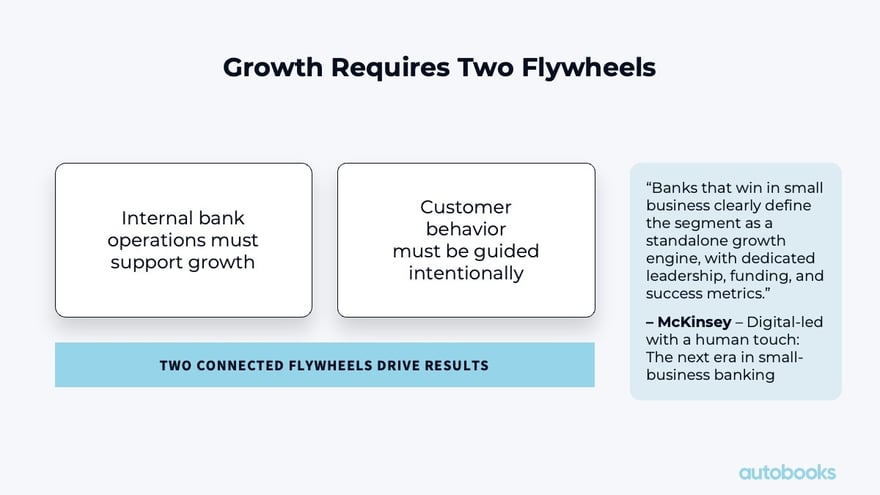
The webinar introduced a clear truth. Growth requires two connected flywheels. The first is internal. Strategy, ownership, product design, launch discipline, and metrics tied to usage. The second is behavioral. Customer engagement does not happen by accident. It must be guided through workflows that reflect how businesses actually operate.
When banks focus on features, results stall. When banks focus on workflows and adoption, deposits and primacy follow.
Why is adoption the real bottleneck in small business banking?
Up to 70% of digital banking initiatives fail to meet adoption targets due to lack of frontline enablement and behavior change strategy .
Availability does not create value. Usage does.
Small business growth is engineered, not announced.
Watch the webinar recording to see how internal alignment becomes the foundation for adoption, usage, and sustainable growth.
|
Frequently asked questions
If demand is strong, why do banks struggle with small business banking?
Because small business usually has no dedicated owner inside the bank. It sits between retail (which designs for consumers) and treasury (which designs for mid-market and up), and the result is products that don't fit the segment and adoption that never compounds.
What does "intentional design" mean for a small business program?
A specific segment, a specific lead capability, a specific adoption target, and a specific owner. Anything less produces a product catalog rather than a growth program.
Why is adoption the bottleneck instead of demand?
Because every FI already holds the small business relationships. The gap isn't customer acquisition — it's converting existing checking accounts into active operating relationships. Adoption is a distribution and activation problem, not a demand problem.
What's the first thing a bank should do?
Pick one segment where the workflow is visible (construction and trades is a common starting point), lead with the capability that matches it (usually payment acceptance), set a 90-day adoption target, and assign an owner.
Does this require new capabilities the bank doesn't have?
Usually not. Most FIs have or can easily add the tools. What's missing is the alignment to deploy them against a specific segment with a specific outcome in mind.