In conversations with banks and credit unions, we’re hearing a sharper focus on business checking, driven by what institutions are seeing in small business behavior and engagement.
In short
- Small business checking products were designed for a customer who no longer exists — the mid-sized business with a dedicated finance team.
- Real small business customers are active but fragmented: they're accepting payments, invoicing, and managing cash outside the bank's checking account.
- When checking becomes the operating center — with invoicing, acceptance, and cash flow visibility built in — engagement, economics, and relevance all move together.
- Doing nothing is not a neutral choice; deposits, fee income, and primacy are actively leaving the bank through third-party tools.
Many institutions are noticing the same pattern. Small business customers are active. They are moving money, accepting payments, juggling tools, and making daily financial decisions. Yet much of that activity is happening outside the checking account itself.
That disconnect is becoming harder to ignore.
Why don't most small businesses fit traditional business checking accounts?
The structure of business checking has not changed much over time, largely because it was built for a different kind of customer.
According to U.S. Census Bureau data, only 9 percent of small businesses earn more than $1 million annually, while 82 percent are non-employer firms averaging under $50,000 in revenue.1 These businesses are typically run by a single owner or a very small team. Many do not use formal accounting software. Most rely on consistent cash flow to stay afloat.
Their needs are simple, but constant. Getting paid. Paying vendors. Understanding where money is coming from and where it’s going. Managing all of it day-to-day.
Traditional business checking, however, still emphasizes features designed for larger organizations. Transaction thresholds. Wire capabilities. Treasury controls. Important tools, but not the ones that shape daily behavior for most small businesses.
What happens when business checking doesn't support the work a small business does?
Small business owners are practical. When their bank does not support a core task, they find another way to do it.
Payments handled through one provider.
Invoicing through another.
Bookkeeping tracked in spreadsheets.
Cash flow managed mentally, often between customer calls.
Despite years of fintech growth, formal adoption remains limited. Based upon estimates, less than 10% of small business use online accounting platforms. The more important insight is not about fintech penetration. It’s that most businesses are still operating without a system at all.
When these workflows live outside the bank, engagement erodes. Deposits scatter. The checking account becomes a place to store money, not a place to run the business.
None of this happens all at once. It happens gradually, quietly, and often without triggering an immediate red flag.
What does a bank lose by leaving business checking unchanged?
As non-bank platforms embed financial services directly into tools small businesses already rely on, they capture more than payments. They capture behavior, visibility, and opportunity.
Over time, that shifts the primary relationship. Not because the checking account disappeared, but because it stopped being central.
This is the risk many institutions are now confronting. Not mass attrition overnight, but slow displacement. Fewer reasons to log in. Fewer moments of engagement. Fewer opportunities to deepen the relationship.
What should modern business checking actually do?
There is an alternative path emerging.
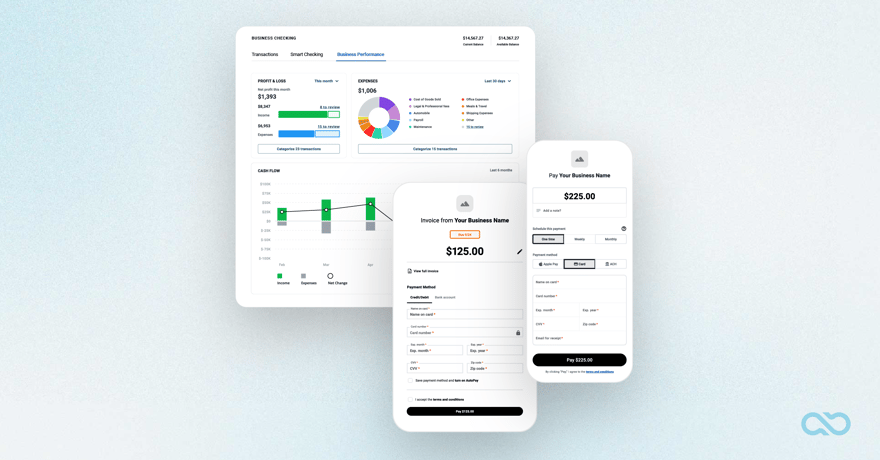
Business checking can evolve from a passive deposit account into an operating hub by bringing essential workflows into the account experience itself.
That means enabling small businesses to:
- Accept customer payments
- Send invoices and payment links
- Manage payables
- See real-time cash flow
- Access basic financial reports
- Surface working capital when gaps appear
This is not about adding complexity. It’s about reducing it. Instead of asking customers to stitch together multiple tools, the checking account becomes the place where financial work actually happens.
Research from Cornerstone Advisors reinforces this shift. 60 percent of businesses say they would obtain accounting and payment services from their bank if offered, and 81 percent of businesses using fintech tools say they would prefer those same capabilities from their primary financial institution.
Demand isn’t missing. Delivery is.
How do engagement, economics, and relevance move together in business checking?
When essential workflows live inside digital banking, behavior changes.
Customers engage more often. Deposits consolidate. The account becomes harder to replace.
Just as importantly, value becomes visible. Institutions gain a clearer path to move beyond free accounts toward pricing models tied to utility and outcomes small businesses recognize.
This is where smarter business checking becomes less about features and more about economics.
What's the biggest challenge for banks modernizing business checking?
For many institutions, the friction isn’t understanding the opportunity. It’s aligning around it.
Product teams see feature gaps.
Digital teams see declining engagement.
Treasury teams see pricing pressure.
Leadership sees fintechs capturing daily relevance.
Each signal is valid. Rarely are they examined together.
Progress starts when those perspectives are connected through a shared understanding of customer behavior, portfolio reality, and the role business checking is meant to play.
What comes next for business checking strategy?
Business checking will always be foundational. The question is whether it remains static or becomes more intentional.
For institutions willing to examine how their small business customers operate, smarter business checking offers a way to strengthen relevance, engagement, and economics at the same time.
That’s the conversation many teams are beginning to have now.
Download the full white paper:
|
1Based upon Autobooks research provided from the SBA, MBO Partners, and the US Census Bureau.
Frequently asked questions
Why isn't traditional business checking enough anymore?
Because it was built for a customer who had a finance team, a physical location, and predictable cash flows. Today's small business customer is often a sole proprietor with variable income, mobile operations, and a toolchain assembled from third-party apps. The account needs to match the work.
What should modern business checking include?
The workflows a business actually runs on: sending invoices, accepting payments, seeing real-time cash flow, and paying bills — all inside the account rather than across a set of disconnected third-party tools.
Why is doing nothing risky?
Because the customer's money is already moving outside the bank's checking account. Every month without a better product is a month of deposits, fee income, and primacy flowing to Square, Bluevine, and other non-bank platforms.
Can a community bank really compete with non-bank platforms?
Yes — banks already have the trust, the regulatory standing, and the existing account base. What they need is the operating layer inside digital banking, not a from-scratch replacement for the relationship.
What's the typical adoption curve when a bank modernizes checking?
It's segment-driven. Pick a segment, lead with the capability that matches it, and activation inside that segment moves within weeks. Broad-based rollouts that don't start with a specific segment typically stall.